


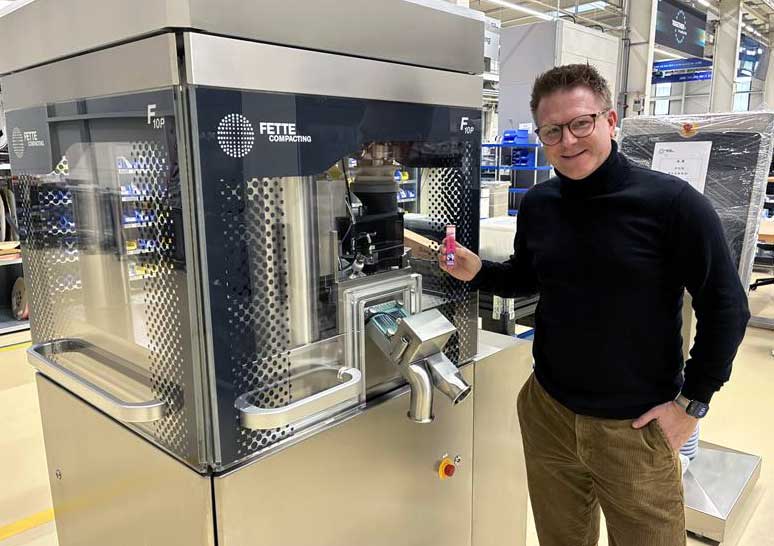
Area Sales Manager Tim Klingenhof in front of the F10p at Fette Compacting in Schwarzenbek.
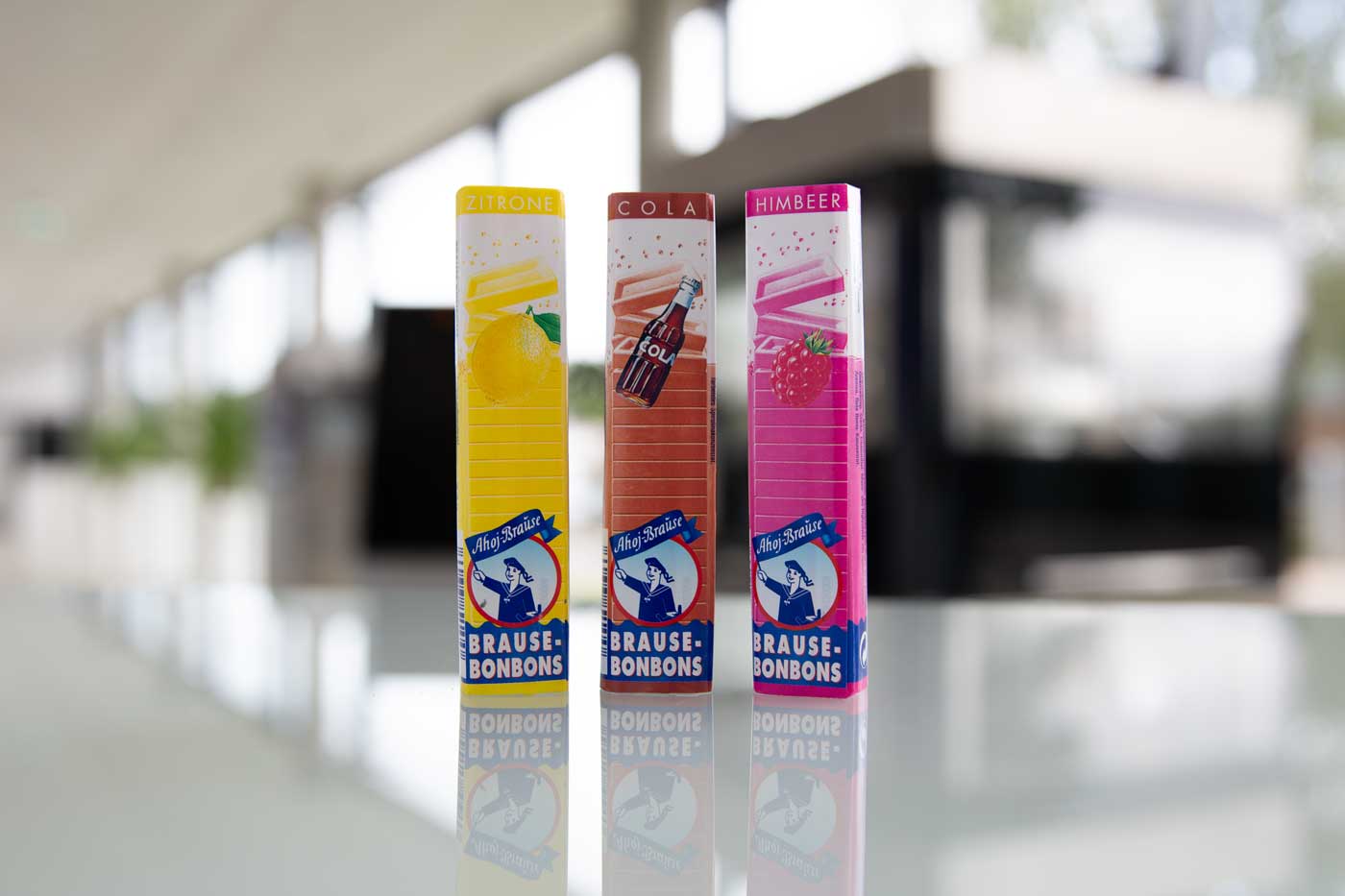
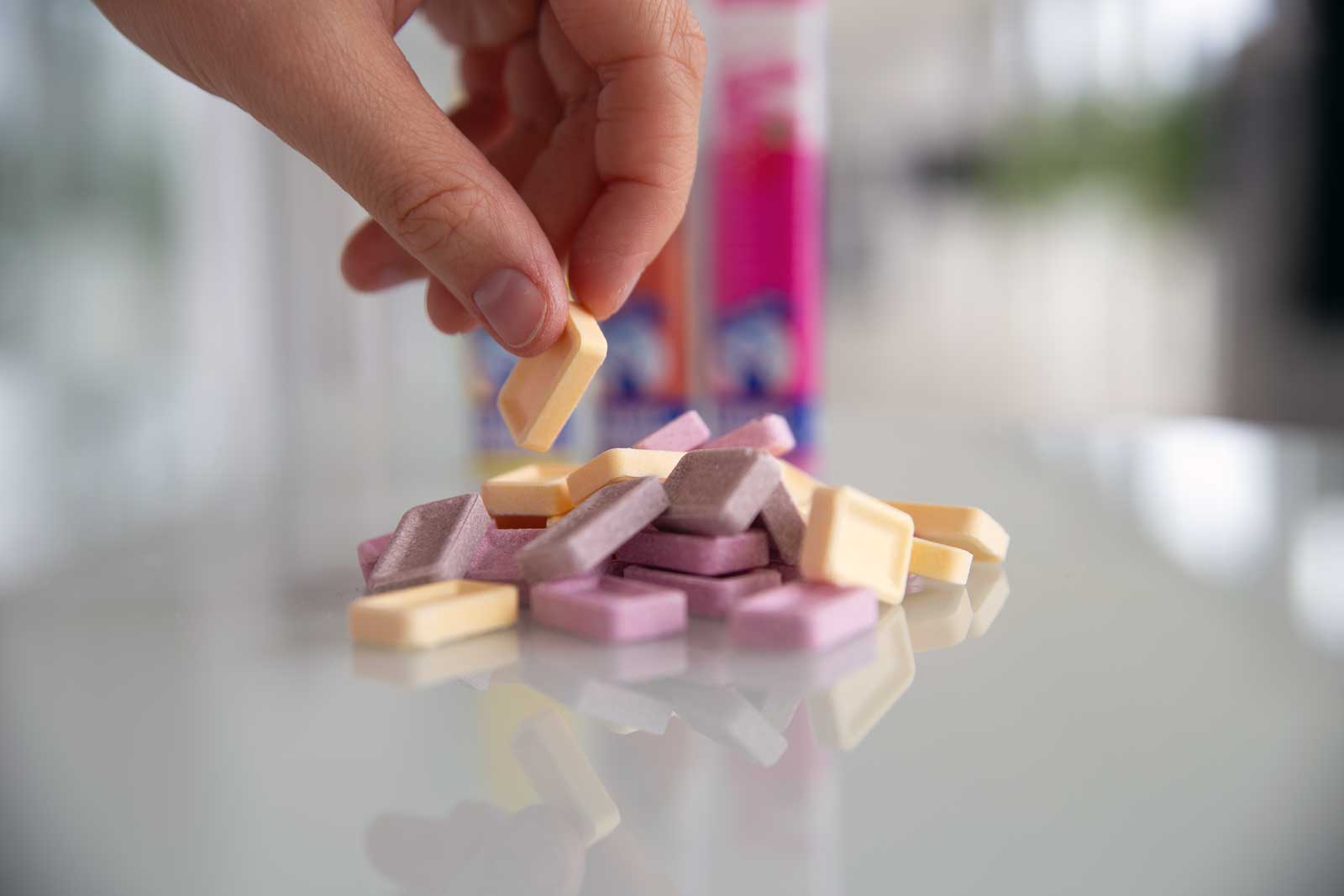
Ahoj-Brause is a name that has been a fixture on German candy store shelves for generations. Behind these familiar products lies a production process that places high technical demands on the equipment. For the manufacture of rectangular effervescent tablets, Ahoj-Brause now relies on the F10p from Fette Compacting. With segment technology and a flatter ejection ramp, the system successfully combines high pressing forces with break-free tablet edges.
Ahoj-Brause has been producing its grape sugar lollipops on tablet presses from Fette Compacting since 1976. “The machines are still running today without requiring significant maintenance. All wear parts are easy to replace, and we can even still get spare parts for our machines, which are nearly 50 years old,” reports Winfried Wöhr, Technical Service at Ahoj-Brause.
For effervescent tablets, the company had previously relied on equipment from other suppliers that was getting on in years. Maintenance costs were rising, downtime was becoming more frequent, repairs required specialized knowledge, and maintaining a spare parts inventory was consuming time and money. So the decision was made to gradually replace the tablet presses. Fette Compacting was the obvious choice. “Amusingly enough, the inquiry came shortly after our marketing team had handed out Ahoj-Brause candies at a meeting,” recalls Tim Klingenhof, Area Sales Manager at Fette Compacting.
A Shape That Packs a Punch
Producing rectangular effervescent tablets is a technical challenge. To ensure they arrive undamaged in their final packaging after pressing, their breaking strength must be between 200 and 350 newtons. This requires pressing forces of between 45 and 60 kN.
Furthermore, during ejection, the machine must first push the tablet upward due to its shape before it can be stripped off to the side. Because of the rectangular shape, edges tend to break off easily during this process. On older machines, the punches were therefore rotated by 30 degrees to reduce the impact during stripping. With the F10p, the question arose: Is this measure really necessary?
Segments Instead of Dies
A key innovation compared to the old systems was the switch to Fette Compacting’s segment technology. The segments replace the rotor’s conventional die discs and the dies themselves. This shortens setup and cleaning times and reduces sources of error during assembly. One question had to be addressed with particular care for the conversion: How should the rectangular tablets be arranged on the segments?
“Together with our tooling and process experts, we decided to arrange the tablets lengthwise on the segment. This has the advantage that, in the event of damage, the segment can simply be rotated 180 degrees, thereby extending its service life. At the same time, however, it also meant that we had to do away with the previous 30-degree rotation of the punches,” explains Tim Klingenhof.
The Moment of Truth
The decisive moment came during the Factory Acceptance Test (FAT), the factory acceptance inspection of the machine prior to delivery. The first test runs using a placebo powder initially raised some concerns: The tablets could not be stripped off satisfactorily, and the desired speed could not be achieved.
When they switched to the actual product, the results improved significantly. In addition, the team at Fette Compacting quickly flattened the angle of the ejection ramp, down which the tablets slide after being ejected from the machine. Instead of a hard impact, the tablets now found a gentle path out. The edge chipping disappeared, and the 30-degree rotation of the punches was a thing of the past. Klingenhof explains: “The tablets came out of the machine in a straight line, and we were even able to exceed the desired output. We were all relieved.”
Proven in Day-to-Day Production
Commissioning at Ahoj-Brause went smoothly. The F10p has been operating trouble-free ever since. Even after extended downtime, parameters such as hardness or weight do not need to be readjusted: A single push of a button is all it takes, and production continues within a stable range. This significantly simplifies operation and reduces scrap.
The F10p’s operating concept, featuring a touchscreen and structured menu navigation, has also proven effective: Multiple user levels ensure that staff see and adjust only the parameters relevant to their specific task. This reduces operating errors and simplifies troubleshooting. Another detail that makes a difference in day-to-day production is the metal-detectable bellows. They prevent oil from entering the product and more than double the main operating time before cleaning is required.
For Fette Compacting, the project also serves as validation: “With the p Series, we have a product that is attractive to the nutrition industry for several reasons. Many customers view us solely as a manufacturer of premium pharmaceutical machinery and don’t expect us to be able to offer high-quality machines in other price segments as well,” says Klingenhof.
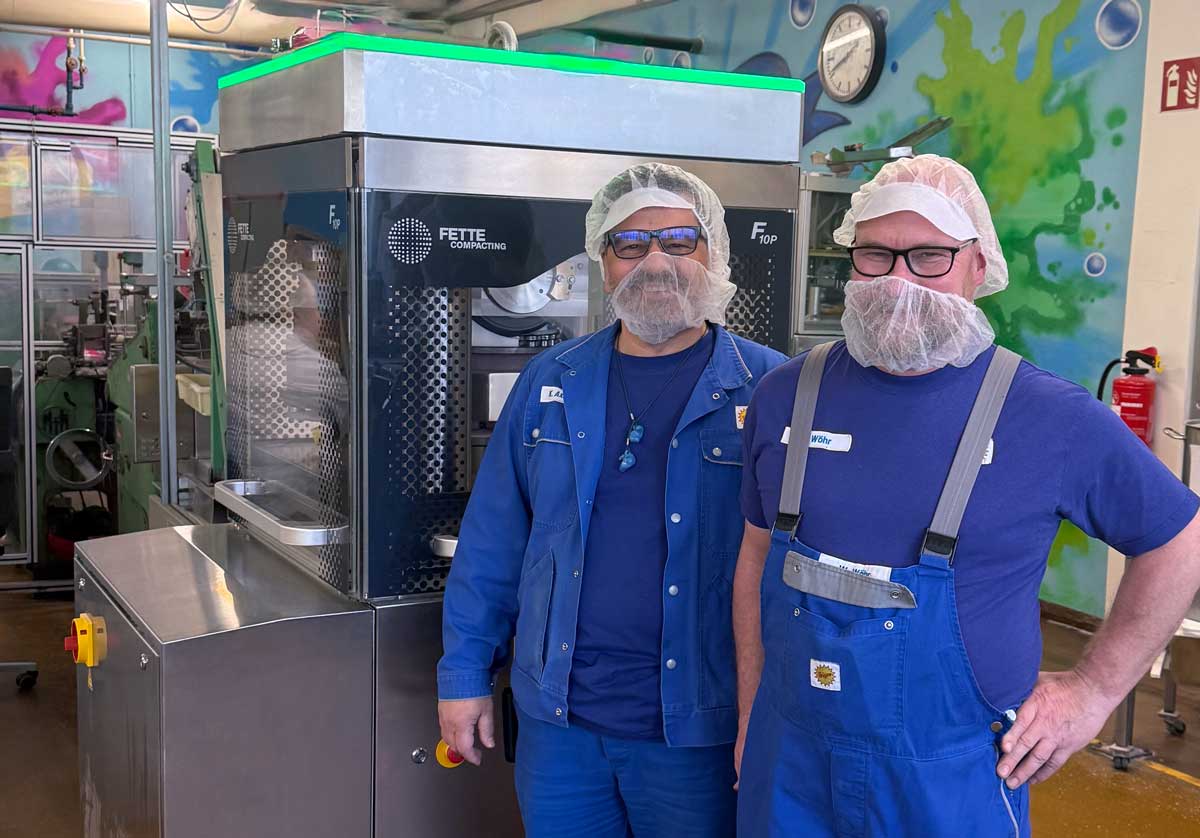
At Ahoj-Brause, they appreciate not only the technology but also the comprehensive service – from consulting and training to tableting tools. “Fette Compacting specifically addressed our needs and didn’t try to sell us any unnecessary bells and whistles. The F10p is an outstanding machine. The installation went smoothly, and it’s particularly easy to maintain and repair. The fact that production has been running trouble-free ever since speaks for itself,” concludes Winfried Wöhr.